Syllabus
CS 478
Natural Language Processing (NLP)
Instructor
Antonis Anastasopoulos (antonis [at] gmu [dot] edu)Office Hours: by appointment.
Teaching Assistant
Joshua Otten (jotten6@gmu.edu)Office Hours: TBD
Meets
Friday, 10:30am to 1:10 PM, Exploratory Hall L102.Course Web Page
https://nlp.cs.gmu.edu/course/cs478-fall26/.We will use Canvas for materials distribution, Gradescope for assignment submission and grading, and Piazza for Q&A (sign up link available here (soon)).
Course Description
Massive amounts of information in our daily life are expressed in natural language. In this class, we will study building computing systems that can process, understand, and communicate in natural language. This field is called natural language processing, or NLP. This class will focus on introducing fundamental concepts in NLP, and will cover techniques and necessary programming skills for building machine learning/deep learning-based NLP models. In the last several classes, we will further study cutting-edge research problems in NLP, including large language models, agents, neural network interpretation, multilingual NLP, and so on.Prerequisites
CS310 (Data Structures), CS330 (Formal Methods and Models), and proficiency in Python programming. Please contact the instructor if you have questions about the necessary background.Class Format
The class will be in-person. Each class will take the following format:- Reading: Before the class, you will be pointed to some reading materials (see "Reading Materials" in the course schedule) . Reading is not required but highly recommended to do before the class.
- Summary/Elaboration/Q&A: In the class, the instructor will summarize important points from the reading material, elaborating on details that were not included in the reading while fielding any questions. New material on cutting-edge methods, or a deep look into one salient method will also be covered.
- Quiz: In some classes, there will be in-class quizzes evaluating student learning performance. The quiz will be based on the content in the previous lectures.
Grading
There will be knowledge checks along the way to assist you in engaging with the material. Your final grade will be dependent on:Semi-Weekly Quizzes: 30%. We will have weekly (for about half of the weeks) in-class quizzes, each containing 2-3 short-answer questions covering contents introduced in previous lectures. The instructor will specify the range one class before the quiz. Each quiz question is worth 5% of the total grade.
Assignments: 50%. There will be four assignments in this class. Each assignment must be completed independently. The use of AI assistants is allowed, as will be described in each of them. Extra credits will be available in most assignments.
- A1: Understand n-gram and neural language models (15%).
- A2: Build a feedforward neural net for sentiment classification, expand it into a BERT-based sentiment classifier, and analyze it (15%).
- A3: Explore Large Language Models (10%).
- A4: Reproduce a seminal NLP paper using AI agents (10%).
Midterm: 10%. There will be a midterm exam covering 10% of your grade. Details TBD.
Final Exam: 10%. There will be a final exam covering 10% of your grade. Details TBD.
Your final letter grade will be given based on:
| Letter Grade | Points (out of 100) |
|---|---|
| A+ | 100+ (w/ extra credits) |
| A | 95-100 |
| A- | 90-94 |
| B+ | 85-89 |
| B | 82-84 |
| B- | 78-81 |
| C+ | 74-77 |
| C | 72-73 |
| C- | 70-71 |
| D | 60-69 |
| F | 0-59 |
Late Day Policy for Assignments:
In case there are unforeseen circumstances that don’t let you turn in your assignment on time, 5 late days total over the four assignments will be allowed. Notes that the late days cannot be used fractionally, e.g., submitting the assignment 1 hour late will incur 1 late day.
Assignments that are late beyond the allowed late days will be graded down by 5% per day.
In the case of a serious illness or other excused absence, as defined by university policies (including providing necessary evidence), coursework submissions will be accepted late by the same number of days as the excused absence. However, students should inform the instructor as soon as they can, ideally before the due date.
Class Attendance Policy:
As we will have quizzes for some classes, attendence is highly suggested. Class will not be recorded. If you miss a quiz, you lose the credits (i.e., no make ups for quiz). However, in the case of a serious illness or other excused absence, as defined by university policies (including providing necessary evidence), students will be excused and the quiz can be taken home. However, students should inform the instructor as soon as they can, before the quiz date.
Readings
Students should be able to understand the course content just by following the lecture and by doing the readings. However, the following textbooks serve as good references.- Jurafsky and Martin, Speech and Language Processing, 3rd edition [online; version Aug 20, 2026] (Referred to as "JM");
- Jacob Eisenstein, Natural Language Processing [online] (Referred to as "Eisenstein");
- Yoav Goldberg, Neural Network Methods in Natural Language Processing [publisher] [online primer pdf] (Referred to as "Goldberg-Publisher/Primer"); Note that the "publisher" version can be downloaded if you use the school VPN.
Tentative Schedule
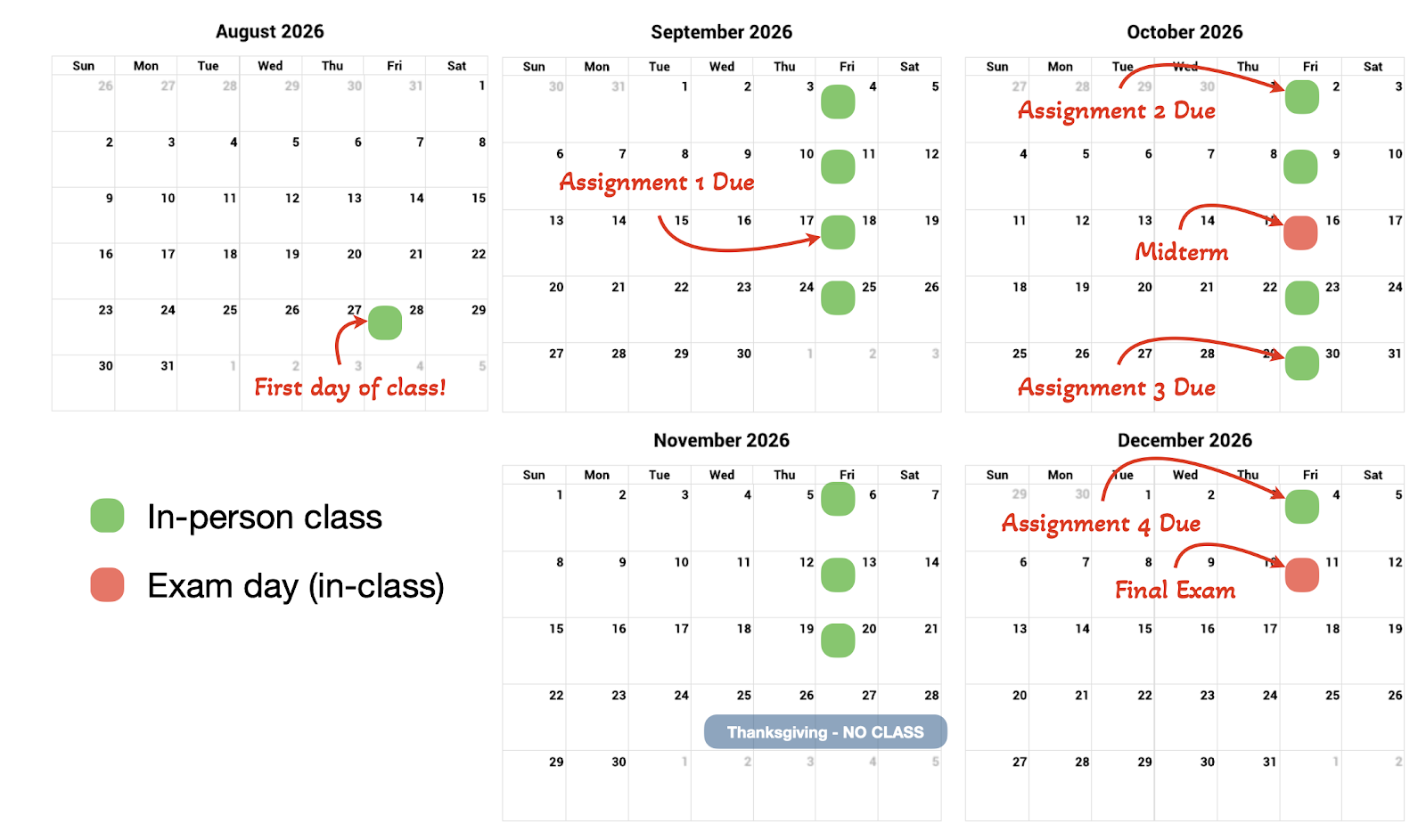
| # | Date | Topic | Reading Materials | Assignment Dates |
|---|---|---|---|---|
| 1 | 08/28 | Introduction, Class Outline Text Processing and Probability Basics |
JM Ch 2 | Assignment 1 Out |
| 2 | 09/04 | Neural Network Basics | JM Ch 6 | |
| 3 | 09/11 | n-gram Language Models and Basic LM Concepts | JM Ch 3 | |
| 4 | 09/18 | ML/NLP Experimental Design Language Representations |
JM Ch 4 and 5 | Assignment 1 Due; Assignment 2 Out |
| 5 | 09/25 | Transformers and Pre-training | JM Ch 7 | |
| 6 | 10/02 | Post-training | TBD | Assignment 2 Due; Assignment 3 Out |
| 7 | 10/09 | Topics on Prompt-based learning and LLM Agents | ||
| 8 | 10/16 | Midterm | ||
| 9 | 10/23 | Topics on Interpretability | ||
| 10 | 10/30 | Topics on Machine Translation | Assignment 3 Due; Assignment 4 Out | |
| 11 | 11/06 | Topics on Syntax and Morphology | ||
| 12 | 11/13 | Topics on Multilinguality | ||
| 13 | 11/20 | Topics on Phonetics and Speech Processing | ||
| 14 | 11/27 | Thanksgiving Break - No Class | ||
| 15 | 12/4 | AI/NLP Ethics Recap |
Assignment 4 Due | |
| 16 | 12/11 | Final Exam |
See below for a compact schedule and (tentative) deadlines: